|
You may have noticed prior references to recursive sequences having "at least" two parts.
It is possible for a recursive formula to involve working with more than one previous term.
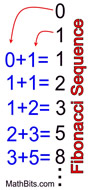
The Fibonacci sequence is a sequence where each term is the sum of the two preceding terms.
{ 0, 1, 1, 2, 3, 5, 8, 13, 21, 34, ... }
History:
The Fibonacci sequence was introduced in 1202 by Leonardo Fibonacci, when the sequence was used to model an idealized rabbit population growth problem.
While Fibonacci numbers appear often in mathematics, they are also applied widely across nature, computer science, finance and art, often relating to the Golden Ratio (1.618).
Computer science uses algorithms reflecting the Fibonacci sequence, such as the Fibonacci search technique and the Fibonacci heap data structure.
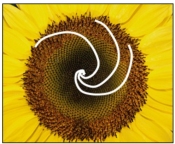
| There are countless biological settings that reflect the Fibonacci numbers: the spiral arrangement of sunflowers seeds, the sprouts of a pineapple, the arrangement of bracts on a pine cone, the arrangement of leaves on a stem, the branching of trees, and many more. The Fibonacci sequence has been referenced as "nature's secret code". |
 |
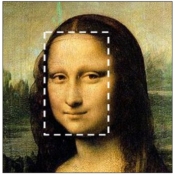
| In the arts and architecture, the Fibonacci sequence is used for the creation of aesthetically pleasing compositions. The ratio between consecutive numbers in the sequence approaches the Golden Ratio. While the Golden Ratio has a prominent spot in mathematics, it is also revered by artists, as it reflects "beauty" and "shapes that appeal to the human eye", such as the dimensions seen in the painting of Mona Lisa. |
|

In its original form, the first term of the Fibonacci sequence was 1.
By modern convention, the sequence now may begin with either 1 or 0,
but typically starts with 0.
{ 0, 1, 1, 2, 3, 5, 8, 13, 21, 34, ... }
Recursive Form:
 |
While we have seen recursive formulas for arithmetic sequences and geometric sequences, there are also recursive formulas for sequences that do not fall into either of these categories.
|
 The Fibonacci sequence is neither an arithmetic sequence nor a geometric sequence. The Fibonacci sequence is neither an arithmetic sequence nor a geometric sequence. |
{ 0, 1, 1, 2, 3, 5, 8, 13, 21, 34, ... }
 Is there a "pattern" for the Fibonacci sequence? Is there a "pattern" for the Fibonacci sequence?
Yes. After the first two terms, each term is the sum of the previous two terms.
Is there a recursive formula for the Fibonacci sequence?
Yes. a1 = 0; a2 = 1; an = an - 1 + an - 2
or f (1) = 0; f (2) = 1; f (n) = f (n - 1) + f (n - 2)
|
|
Notice that it was necessary to declare both the first and second term, before stating the formula for generating the remaining terms. |
|
Explicit Form:
While developing an explicit formula for an arithmetic sequence or a geometric sequence can seem difficult at times, it will actually be "easy" as compared to finding explicit formulas for sequences that do not fall into those categories.
 |
{ 0, 1, 1, 2, 3, 5, 8, 13, 21, 34, 55, ... }
You could spend a long time trying to turn the "pattern" of this sequence into an "explicit formula" for the Fibonacci sequence.
|
Is there a "pattern" in the Fibonacci sequence?
Yes. After the first two terms, each term is the sum of the previous two terms.
Is there an explicit formula for the Fibonacci sequence? Yes.
Explicit Formula: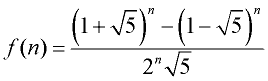
|
|
Don't panic! You will not be asked to find explicit formulas of this difficulty level. But you may be asked to "use" a more difficult formula that is given. |
|
|
|
|
Graph: |
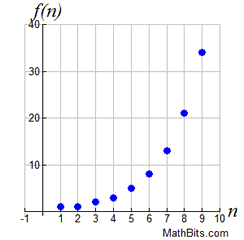
What about the graph of the Fibonacci sequence?
As seen at the right, when graphed, the Fibonacci sequence takes on the "appearance" of an exponential graph.
BUT ...
Unlike the recursive forms for arithmetic and geometric sequences, the Fibonacci sequence is not truly exponential.
The Fibonacci sequence can, however, be "modeled" using an exponential function. With the sequence's connection to the Golden Ratio, it can be "modeled" by an exponential function with 1.6 as the base, f (x) = 1.6x.
(This is a "model", not an exact formula match.) |
 |
|
|
Arrow down to
"In Func MODE" |
|

NOTE: The re-posting of materials (in part or whole) from this site to the Internet
is copyright violation
and is not considered "fair use" for educators. Please read the "Terms of Use". |
|
|