|
Algebra 1 examined Arithmetic Sequences in explicit form.
In Algebra 2, Arithmetic Sequences will be examined in both
explicit and recursive forms, along with patterns for creating formulas for the sequences.
 |
An arithmetic sequence is a sequence of numbers where the difference between consecutive terms is constant, called the common difference (d).
Pattern: a, (a + d), (a + 2d), (a + 3d), ... where a is the first term. |
|

Arithmetic Sequence Explicit Formula:
(Linear Function) |

Add |
|
An explicit formula will create a sequence using n, the number location of each term.
If you can find an explicit formula for a sequence, you will be able to quickly and easily find any term in the sequence simply by replacing n with the number of the term you seek.
The explicit formula for an arithmetic sequence defines any term, an, in the sequence based upon its position, n, in the sequence. It does not require knowledge of any previous terms.
|
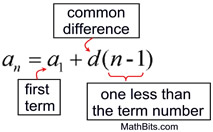
FORMULA: an = a1 + d (n - 1)
a1 = first term, d = common difference, n = term number
It may be written in either subscript notation an, or in functional notation, f (n). |
common difference |
|
Let's start our investigation with an example of an arithmetic sequence and
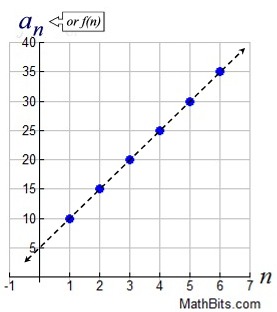
see what the graph
can tell us about the sequence's explicit formula.
 Sequence:
{10, 15, 20, 25, 30, 35, ...}. Find an explicit formula. Sequence:
{10, 15, 20, 25, 30, 35, ...}. Find an explicit formula.
This is an arithmetic sequence where the same number, 5, is added to each term to get to the next term.
Term Number |
Term |
Subscript Notation |
Function Notation |
1 |
10
|
a1 |
f (1) |
2 |
15
|
a2 |
f (2) |
3 |
20
|
a3 |
f (3) |
4 |
25
|
a4 |
f (4) |
5 |
30
|
a5 |
f (5) |
6 |
35
|
a6 |
f (6) |
n |
|
an |
f (n) |
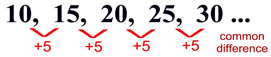 add "d " to each term
Explicit Formula for this example:
in subscript notation: an = 5n + 5
in function notation: f (n) = 5n + 5 |
|
The sequence's graph is only the dots (terms) in the first quadrant. An invisible "line" containing the terms (dots) shows a slope of 5 over 1, with a projected y-intercept of 5.
Using y = mx + b, we can obtain a linear formula, y = 5x + 5, that will pass through the terms from the sequence.
Relabel y = an and x = n to get an = 5n + 5,
an "explicit formula" for just the dots (terms),
since the sequence's domain is limited to just the positive integers.
|
 Arithmetic sequences are discrete linear functions. Arithmetic sequences are discrete linear functions.
("discrete" means the dots are a scatter plot and the dots are not connected)
While the n value increases by a constant value of one, the an value increases by a constant value of 5 (for this graph)
This creates the "dots (terms)" along an invisible "line" with a slope of 5.
The common difference, d, between the terms in an arithmetic sequence
is a "rate of change" compatible to the slope, m, in a linear function.
Click here to see: Will ALL arithmetic sequences be discrete linear functions?
|
|
 |
Origins of the Arithmetic Explicit Formula
In
the example above, we were able to find an "explicit formula" for the sequence by examining the graph of the terms and the "line" containing the terms. Formula from the graph: an= 5n + 5. |
So where did the stated "explicit formula", an = a1 +(n - 1) d, come from,
and is it the same as the formula from the graph?
The key to the "explicit formula" is found by
examining the pattern of an arithmetic
sequence.
|
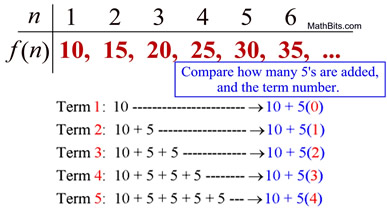
If you compare the term number with how many times the common difference, 5, is added, you will see the pattern.
Explicit formula: an = a1 +(n - 1)d
an = 10 + (n - 1)5
[Simplifies to an= 5n + 5] same as graph
or f (n) = 10 + 5(n - 1)
|
|
Generally speaking, the common difference, d, is repeatedly added to each term.
The number of d 's added to each term is one less than the number of the term. |

Notice that the coefficient of d is always one less than the location of the term (n).
Explicit Formula to find any term
of an arithmetic sequence:

where a1 is the first term of the sequence,
d is the common difference,
n is the number of the term to find.
Also written as: an = a1 + d (n - 1)
(to emphasize the distribution of d across the parentheses) |
There are numerous ways to work with arithmetic sequences and explicit formulas. Let's take a look at some of the situations.
| Question |
Answer |
1. Find the common difference for this arithmetic sequence
5, 9, 13, 17 ...
|
1. The common difference, d, can be found by subtracting the first term from the second term, which in this problem yields 4. Checking shows that 4 is the difference between all of the entries.
|
2. Find the common difference for the arithmetic sequence whose explicit formula is
an = 6n + 3 |
2. The formula indicates that 6 is the value being added (the common difference). The common difference is the slope of the linear line. A listing of the terms will also show what is happening in the sequence (start with n = 1).
9, 15, 21, 27, 33, ...
The list shows the common difference is 6. |
3. Find the 10th term of the sequence
3, 5, 7, 9, ... |
3. n = 10; a1 = 3, d = 2
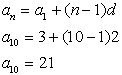
The tenth term is 21. |
4. Find a7 for an arithmetic sequence where
a1 = 3x and d = -x. |
4. n = 7; a1 = 3x, d = -x
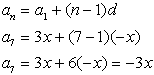
a7 = -3x |
5. Find t15 for an arithmetic sequence where
t3 = -4 + 5i and t6 = -13 + 11i
Using:
larger subscript - smaller subscript + 1
will count the number of terms. |
|
5. Notice the change of labeling from a to t. The letter used in labeling is of no importance.
Get a visual image of this problem

Using the third term as the "first" term, find the common difference from these known terms.
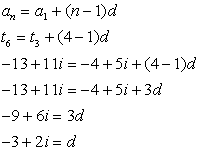
Now, from t3 to t15 is 13 terms (n = 13)
an = a1 +(n - 1)d.
t15 = -4 + 5i + (13 - 1)(-3 + 2i)
= -4 + 5i - 36 + 24i
= -40 + 29i |
6. Find an explicit formula for the sequence
1, 3, 5, 7, ...
|
6. The sequence is arithmetic with a common difference of 2. A formula like an = 2n gives 2, 4, 6, 8, ... where each term is one more than what we want them to be. Subtracting one should do the job.
an = 2n - 1
Check: Substituting n = 1, gives 1.
Substituting n = 2, gives 3, and so on.
Or use the formula: an = a1 + d (n - 1)
an= 1 + 2 (n - 1)
an= 1 + 2n - 2
an= 2n - 1 |
7. Find the 25th term of the sequence
-7, -4, -1, 2, ... |
7. Be careful of the negative sign.
n = 25; a1 = -7, d = 3
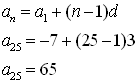
Ans: 65 |
8. Insert 3 arithmetic means between 7 and 23.
| Note: In this context, an arithmetic mean is the term between any two terms of an arithmetic sequence. It is simply the average (mean) of its surrounding terms. |
|
8. While there are several solution methods, we will use our arithmetic sequence formula.
Draw a picture to better understand the situation.
7, ____, ____, ____, 23
This set of terms will be an arithmetic sequence.
We know the first term, a1, the last term, an, but not the common difference, d.
Find the common difference:
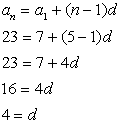
The common difference is 4.
Now, insert the terms using d.
7, 11, 15, 19, 23 |
9. Find the number of terms in the sequence
7, 10, 13, ..., 55.
| Note: n must be an integer! |
|
9. a1 = 7, an = 55, d = 3.
We need to find n.
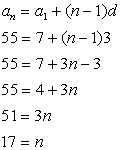
When solving for n, be sure your answer is a positive integer. There is no such thing as a fractional number of terms in a sequence!
Ans. 17 terms |
10. Write an explicit formula for the sequence:
{18, 22, 26, 30, ...}
and then find the 100th term. |
10. We know a1 = 18 and d = 4.
Use the formula: an = a1 + d (n - 1)
an= 18 + 4 (n - 1)
an= 18 + 4n - 4
an= 4n + 14
Find the 100th term of this sequence.
Simply replace n with 100.
a100= 4(100) + 14 = 414 |
| 11. The first three terms of an arithmetic sequence are represented by x + 5, 3x + 2, and 4x + 3 respectively. Find the numerical value of the 10th term of this sequence. |
Represent the common difference between the terms:
(3x + 2) - (x + 5) = 2x - 3 (the common difference)
(4x + 3) - (3x + 2) = x + 1 (the common difference)
Since the common difference must be constant, set these values equal. Solve for x.
2x - 3 = x + 1
x = 4
The sequence is 9, 14, 19, ...,
common difference of 5.
The 10th term = a10 = 9 + (10 - 1)(5) = 54 |
To summarize the process of writing an explicit formula for an arithmetic sequence:
1. Determine if the sequence is arithmetic.
(Do you add, or subtract, the same amount from one term to the next?)
2. Find the common difference. (The number you add or subtract to each term.)
3. Create an explicit formula using the pattern of the first term added to the product of the common difference and one less than the term number.
an= a1 + d (n - 1) |
an = the nth term in the sequence
a1 = the first term in the sequence
n = the term number
d = the common difference. |
|
{10, 15, 20, 25, 30, 35, ...} |
first term = 10, common difference = 5
explicit formula: an= 10 + 5(n - 1)
= 10 + 5n - 5 = 5 + 5n or 5n + 5 |
|
|
|
How to use your graphing calculator for working
with
sequences
Click here. |
|
|
|
How to use
your graphing calculator for
working
with
sequences
Click here. |
|
|

NOTE: The re-posting of materials (in part or whole) from this site to the Internet
is copyright violation
and is not considered "fair use" for educators. Please read the "Terms of Use". |
|