|
Algebra 1 examined Geometric Sequences in explicit form.
In Algebra 2, Geometric Sequences will be examined in both
explicit and recursive forms, along with patterns for creating formulas for the sequences.
 |
A geometric sequence is a sequence of numbers where each term after the first is found by multiplying the previous term by a fixed, non-zero number, called the common ratio (r).
Pattern: a, a • r, a • r2, a • r3, ... where a is the first term. |
|

Geometric Sequence Explicit Formula:
(Exponential Function) |

Multiply |
|
An explicit formula will create a sequence using n, the number location of each term.
If you can find an explicit formula for a sequence, you will be able to quickly and easily find any term in the sequence simply by replacing n with the number of the term you seek.
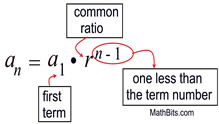
The explicit formula for an geometric sequence defines any term, an, by directly using the first term, a1, common ratio, r, and the term's position, n.
|
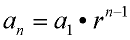
FORMULA: an = a1• r n - 1
a1= first term, r = common ratio, n = term number
It may be written in either subscript notation an, or in functional notation, f (n). |
|
|
Let's start our investigation with an example of a geometric sequence and
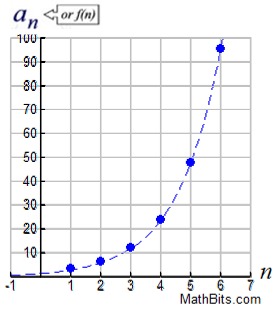
see what the graph
can tell us about the sequence's explicit formula.
 Sequence:
{3, 6, 12, 24, 48, 96, ...}. Find an explicit formula. Sequence:
{3, 6, 12, 24, 48, 96, ...}. Find an explicit formula.
This is a geometric sequence where the same number, 2, is multiplied times each term to get the next term..
Term Number |
Term |
Subscript Notation |
Function Notation |
1 |
3 |
a1 |
f (1) |
2 |
6 |
a2 |
f (2) |
3 |
12 |
a3 |
f (3) |
4 |
24 |
a4 |
f (4) |
5 |
48 |
a5 |
f (5) |
6 |
96 |
a6 |
f (6) |
n |
|
an |
f (n) |
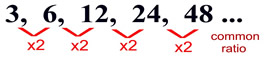 multiply each term by "r"
Explicit Formula for this example:
in subscript notation: an = 3 • (2)n - 1
* in function notation: f (n) = 3 • (2)n - 1
or f (n) = 1.5 • (2)n
|
|
The sequence graph is only the dots (terms) in the first quadrant. A graph of the invisible "curve line" connecting the terms is an exponential function of the form (y = a•bx).
With a "recursive" formula, we are working with repeated multiplication which is also true for an exponential function.
*When the graphing calculator is used to create an exponential regression equation for this data, the equation f (x) = 1.5• 2x is created. If we manipulate the exponent, we can get f (x) = 1.5 • 2 • 2 x-1,
which is f (x) = 3 • 2 x-1.
Click the link in the next box to see why this manipulation is necessary.
|
 Geometric sequences are discrete exponential functions. Geometric sequences are discrete exponential functions.
("discrete" means the dots are a scatter plot and the dots are not connected)
While the n value increases by a constant value of one, the an value increases by multiples of r, the common ratio, which is 2 (for this graph).
The common ratio, r, corresponds to the base, b, of an exponential function.
Click here to see: Will ALL geometric sequences be discrete exponential functions?
|
 |
Origins of the Geometric Explicit Formula
In the example above, we were able to find an "explicit formula" for the geometric sequence by examining the graph of the terms and the "exponential curve" containing the terms. Formula from the graph: f (x) = 1.5 • 2x - 1.
|
So where did the stated "explicit formula", an = a1• r n - 1, come from,
and is it the same as the formula from the graph?
The key to the "explicit formula" is found by examining the pattern of the geometric sequence.
|
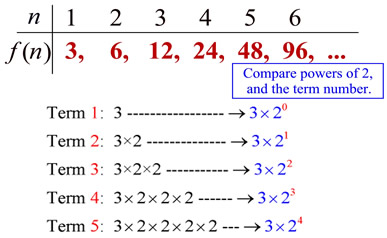
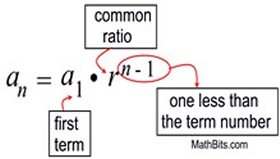
If you compare the term number with the powers of the common ratio, 2, you will see a pattern for an explicit formula:
|
Explicit formula: an = 3 • 2n - 1
|
|
→ |
Same as the graphed formula :
f (x) = 1.5 • (2)x or f (x) = 3 • 2 x - 1 |
|
Generally speaking, the common ratio, r, is repeatedly multiplied times each term.
The number of r 's multiplied times each term is one less than the number of the term.
Pattern by definition: a, a • r, a • r2, a • r3, . . . (a being the first term)

Notice the number of times "r" is multiplied is one less than the location of the term (n).
|
Explicit Formula to find any term
of a geometric sequence:
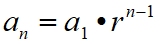
where a1 is the first term of the sequence,
r is the common ratio,
n is the number of the term to find.
|
|
There are numerous ways to work with geometric sequences and explicit formulas. Let's take a look at some of the situations.
| Question |
Answer |
1. Find the common ratio for the geometric sequence
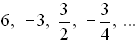 |
1. The common ratio, r, can be found by dividing the second term by the first term, which in this problem yields -1/2.
Checking shows that multiplying each entry by -1/2 yields the next entry. |
2. Find the common ratio for the geometric sequence given by the formula
an = 5 • 3n - 1 |
2. The formula indicates that 3 is the common ratio by its position in the formula. A listing of the terms will also show what is happening in the sequence (start with n = 1).
5, 15, 45, 135, ...
The list also shows the common ratio to be 3. |
3. For the sequence:
{3, 12, 48, 192. ...}.
a) Write an explicit formula.
b) Find the tenth term of the sequence. |
3. First notice that the sequence is geometric. Each term is multiplied by 4.
a) We know a1 = 3 and r= 4.
Use the formula: an = a1 • rn - 1
an = 3 • 4n - 1
b) Simply replace n with 10.
a10= 3 • 49 = 786,432 |
4. Find the 7th term of the sequence
2, 6, 18, 54, ... |
4. The sequence is geometric: multiple of 3.
n = 7; a1 = 2, r = 3
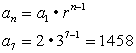
The seventh term is 1458.
|
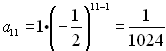
5. Find the 11th term of the geometric sequence
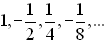 |
5. n = 11; a1 = 1, r = -½
 |
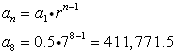
6. Find a8 for the geometric sequence
0.5, 3.5, 24.5, 171.5, ...
|
6. n = 8; a1 = 0.5, r = 7
 |
| 7. The third term of a geometric sequence is 3 and the sixth term is 1/9. Find the first term.
|
7. Think of the sequence as "starting with" 3, until you find the common ratio.
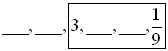
For this modified sequence:
a1 = 3, a4 = 1/9,
n = 4 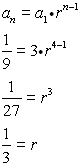
Now, work backward multiplying by 3 (or dividing by 1/3) to find the actual first term.
a1 = 27
|
8. Insert three geometric means between 4 and 324.
| Note: In this context, a geometric mean is the term between any two terms of a geometric sequence. |
|
Again, visualize the situation.
4, ___, ___, ___, 324
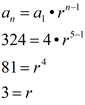
Now, insert the terms using r:
4, 12, 36, 108, 324 |
9. Find the number of terms in the geometric sequence:
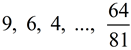 |
By observation: a1 = 9, an = 64/81, r = 2/3.
We need to find n.
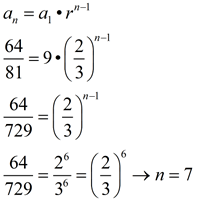
In this problem, n - 1 = 6, so n = 7. When solving for n, be sure your answer is a positive integer. There is no such thing as a fractional number of terms in a sequence! |
10. A ball is dropped from a height of 8 feet. The ball bounces to 80% of its previous height with each bounce. How high (to the nearest tenth of a foot) does the ball bounce on the fifth bounce?
|
10. Set up a model drawing for each "bounce".
6.4, 5.12, ___, ___, ___
The common ratio is 0.8.
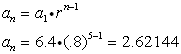
Answer: 2.6 feet |
To summarize the process of writing an explicit formula for a geometric sequence:
1. Determine if the sequence is geometric
(Do you multiply, or divide, the same amount from one term to the next?)
2. Find the common ratio. (The number you multiply or divide.)
3. Create an explicit formula using the pattern of the first term multiplied by the common ratio raised to a power of one less than the term number.
|
an = the nth term in the sequence
a1 = the first term in the sequence
n = the term number
r = the common ratio |
|
{3, 6, 12, 24, 48, 96, ...} |
first term = 10, common ratio = 2
explicit formula: an= 3 • 2n - 1
|
|
|
How to use your graphing calculator for working
with
sequences
Click here. |
|
|
|
How to use
your graphing calculator for
working
with
sequences
Click here. |
|
|

NOTE: The re-posting of materials (in part or whole) from this site to the Internet
is copyright violation
and is not considered "fair use" for educators. Please read the "Terms of Use". |
|