|
In addition to investigating explicit forms,
Algebra 2 also examines Geometric Sequences in recursive forms.
 |
A geometric sequence is a sequence of numbers where each term after the first is found by multiplying the previous term by a fixed, non-zero number, called the common ratio (r).
Pattern: a, a • r, a • r2, a • r3, ... where a is the first term. |
|

Geometric Recursive Formula:
(Exponential Function) |

Multiply |
|
In a recursive formula, each term is defined as a function of its preceding term(s).
[Each term is found by doing something to the term(s) immediately in front of that term.]
It is easy to recognize a "recursive formula" because it will always contain at least two parts.
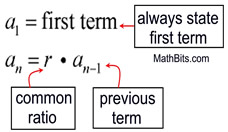
The recursive formula for an geometric sequence defines each term based upon the preceding term by multiplying a constant common ratio, r. It primarily requires two components: the first term, a1, and the formula for the next term, an, based upon the previous term, an - 1.
|
FORMULA: a1= starting value, an = r • an - 1
a1= first term, r = common ratio, n = term number
It may be written in either subscript notation an, or in functional notation, f (n). |
|
|
We are going to take another look at the examples we saw under "explicit" form
to see the differences, and similarities, when the "recursive" form is used.
 Sequence:
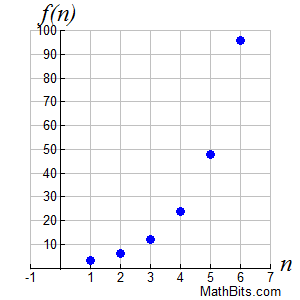
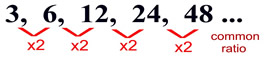
{3, 6, 12, 24, 48, 96, ...}. Find a recursive formula. Sequence:
{3, 6, 12, 24, 48, 96, ...}. Find a recursive formula.
This is a geometric sequence where the same number, 2, is multiplied times each term to get the next term..
Term Number |
Term |
Subscript Notation |
Function Notation |
1 |
3 |
a1 |
f (1) |
2 |
6 |
a2 |
f (2) |
3 |
12 |
a3 |
f (3) |
4 |
24 |
a4 |
f (4) |
5 |
48 |
a5 |
f (5) |
6 |
96 |
a6 |
f (6) |
n |
|
an |
f (n) |
Recursive Formula:
in subscript notation: a1 = 3; an = 2 • an - 1
in function notation: f (1) = 3; f (n) = 2 • f (n - 1)
|
|
Again, the sequence graph is only the dots (terms) in the first quadrant. A graph of the invisible "curve line" connecting the terms is an exponential function of the form (y = a • bx).
The domain of the sequence is the positive integers only.
|
 |
In most geometric sequences, a recursive formula is easier to create than an explicit formula. The common ratio is usually easily seen, which is then used to quickly create the recursive formula.
  |
|
Origins of the Geometric Sequence Recursive Formula
The origin of this recursive formula for a geometric sequence, where the common ratio is r, can be found by examining the geometric sequence's pattern, from its definition.
The common ratio is the term being used to multiply times the previous term.
Pattern: a, a • r, a • r2, a • r3, ... where a is the first term. (explicit)
 (recursive) (recursive)
If you start with the recursive pattern, as stated in the definition of a geometric sequence, and list out all of the "r"s in each term, you can see how the recursive formula was developed by "grouping" within the pattern.
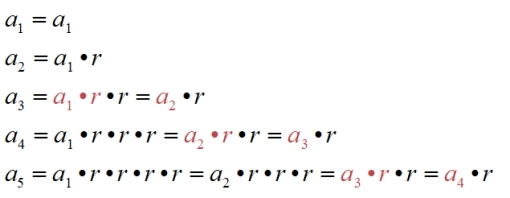
 The recursive formula shows that given a1, The recursive formula shows that given a1,
each term can be expressed
as the preceding term times "r". |
|
|
Recursive Formula
of an geometric sequence:
Given a1and an= r • an - 1
where a1 is the first term of the sequence,
r is the common ratio,
n is the number of the term to find. |
| Question |
Answer |
1. Find the first 5 terms of this recursive geometric sequence:
a1 = 3
an = 5 • an - 1 |
1. The formula shows that each term is five times the term in front of it. This one is easy to see.
3, 15, 75, 375, 1875, ... |
2. Find the first 5 terms of this recursive geometric sequence.
a1 = 4
an = (-1)n • 2 • an - 1 |
2. The formula indicates that each term is two times the term in front of it, times some power of negative one. Work carefully.
Another easy one.
4, 8, -16, - 32, 64, ...
|
3. Write a recursive formula for this geometric sequence.
80, 40, 20, 10, 5, ...
|
3.The first term is 80.
Each term following is half of the preceding term, giving a common ratio of ½.
a1 = 80
an = ½ • an - 1
The formula is easy since you can quickly see the pattern in the sequence. |
4. For the geometric sequence:
1, 0.5, 0.25, 0.125. ...
a) Find the next two terms.
b) Write a recursive formula for this sequence. |
4. a) 1, 0.5, 0.25, 0.125. 0.0625, 0.03125
b) a1 = 1
an = 0.5 • an - 1
This is another example of multiplying by ½, but is a bit harder to see in decimal form. |
5. Write a recursive formula for this geometric sequence.
-1, 4, -16, 64, ... |
5. The first term is -1.
Each term is -4 times the term in front of it.
a1 = -1
an = -4 • an - 1
|
6. Write a recursive formula for this geometric sequence.
-3, -12, -48, -192, ...
|
6. The first term is -3.
Each term is 4 times the term in front of it.
a1 = -3
an = 4 • an - 1 |
7. The first term of an geometric sequence is 2 and the third term is 18. Write a recursive formula to express this sequence.
You can find a geometric mean between two numbers by multiplying the two numbers and taking the square root.
2 • 18 = 36
The square root of 36 is 6. |
|
7. Get a visual of the situation: 2, ___, 18
In the pattern for a geometric sequence, the third term, 18, would be 2 • r • r.
2 r2 = 18
r2 = 9
r = 3
The missing term is 2 • 3 = 6.
a1 = 2
an = 3 • an - 1 |
8. For the geometric sequence:
{-4, 12, -48, 192, ...}
a) Write a recursive formula for this sequence.
b) Find the 100th term of this sequence. |
a) We know a1 = -4 and r = -3.
a1 = -4 and an = -3 • an - 1
b) NOPE!! As we have seen before, trying to use a recursive formula to find a specific term that is far from the first term,
is a waste of time.
Remember, to use a recursive formula,
we would need
to find all of the terms prior to the 100th term. (Use an explicit formula and a calculator.) |
|
To summarize the process of writing a recursive formula for a geometric sequence:
1. Determine if the sequence is geometric
(Do you multiply, or divide, the same amount from one term to the next?)
2. Find the common ratio. (The number you multiply or divide.)
3. Create a recursive formula by stating the first term, and then stating the formula to be the common ratio times the previous term.
a1 = first term;
an= r • an - 1 |
a1 = the first term in the sequence
an = the nth term in the sequence
an - 1 = the term before the nth term
n = the term number
r = the common ratio |
|
{3, 6, 12, 24, 48, 96, ...} |
first term = 3, common ratio = 2
explicit formula: an= 3 • 2n - 1
|
|
|
How to use your graphing calculator for working
with
sequences
Click here. |
|
|
|
How to use
your graphing calculator for
working
with
sequences
Click here. |
|
|

NOTE: The re-posting of materials (in part or whole) from this site to the Internet
is copyright violation
and is not considered "fair use" for educators. Please read the "Terms of Use". |
|